Post by Adrianna Bugliarello-Wondrich, SC&I, MI student. January 2026.
This past summer, Rutgers University Libraries (RUL) began working with the Institute for Women’s Leadership (IWL) to develop the IWL Archives Digital Project. This venture is dedicated to preserving the memory of select IWL initiatives in a digital space– the Rutgers University Community Repository (RUcore). The IWL Archives Digital Project aims to create digital access points for three major components: videos from the Dialogues with IWL Director Alison R. Bernstein interview series, student works from the IWL Leadership Scholars Certificate Program, and, in collaboration with Rutgers Special Collections & University Archives, the Leadership Scholars Certificate Program archives. This latter component consists of a collection of files donated by Mary Trigg, the founding director of the Leadership Scholars Certificate Program and former chair of the Department of Women’s, Gender and Sexuality Studies (WGSS).
The IWL, founded in 1991, is a consortium of Rutgers women’s institutes, centers, and programs. The IWL has dedicated itself to decades of research and education-focused projects addressing the underrepresentation of women in leadership. The IWL Leadership Scholars Certificate Program is a selective, two-year certificate program aimed at developing “informed, innovative, and socially responsible leaders”, as stated on the IWL website. Throughout the two years of this program, students learn and develop skills in feminist leadership through specialized coursework, professional experience, and practice. The program curriculum features two major projects.
In the first semester, students conduct an interview with a notable figure in women’s leadership, building intergenerational feminist ties. In years with extra funding, students used these interviews as a basis for creating short documentaries exploring what they learned about women’s leadership and their own potential as leaders through the content and process of the interviews (this set of videos is titled the Transforming Lives documentary series). Over the following two semesters in the program, students lead the way by developing an individual Social Action Project (SAP) that addresses a social issue through action. It’s difficult to explain the wide breadth of amazing work accomplished through these projects with any brevity, so feel free to check out the current digital home for students’ final presentations of their SAPs. Both of these major projects are set to be captured in the IWL Archives Digital Project.
As it just so happens, I myself was in the IWL Leadership Scholars Certificate Program during my time as an undergraduate at Rutgers University. I am now a graduate student in Rutgers’s Master of Information program. Given my intersecting interests in academic librarianship and Women’s, Gender, & Sexuality Studies, I reached out to Kayo Denda, the WGSS liaison librarian and head of the Margery Somers Foster Center, to learn about her role at RUL. Serendipitously, Kayo received the go-ahead to begin work on the IWL digital archive a few months later. Knowing that I was a graduate of the IWL’s Leadership Scholars Certificate Program and had a strong interest in gaining academic library experience, Kayo reached out to ask me if I’d be willing to join her to work on the project. My answer, of course, was yes!
The Leadership Scholars Certificate Program was incredibly transformative for me in developing self-confidence in my potential as a leader when I was an undergraduate student. From the start, it was clear that my aptitude for success was already fully trusted by the program’s administrators and faculty: the program was willing to invest financial, educational, and moral support into my work as a leader. This external faith in my abilities was hugely imperative in jumpstarting my faith in myself and allowing me to step into professional and activist spaces bearing full confidence.
The IWL has fostered this kind of growth among undergraduate women for decades and has worked to amplify the voices of all types of women leaders across disciplines and across the globe. The purpose of the IWL Archives Digital Project is to dedicate a space to preserving this work for years to come. The materials represent a sample of the value of the IWL’s programs in advancing women’s voices and leadership, not only documenting the work done through the IWL, but also creating a template for future programs at other institutions. This project will allow these resources to be stored in a more stable infrastructure that can reliably support long-term file preservation and will create an interface that will promote increased user discovery of the resources.
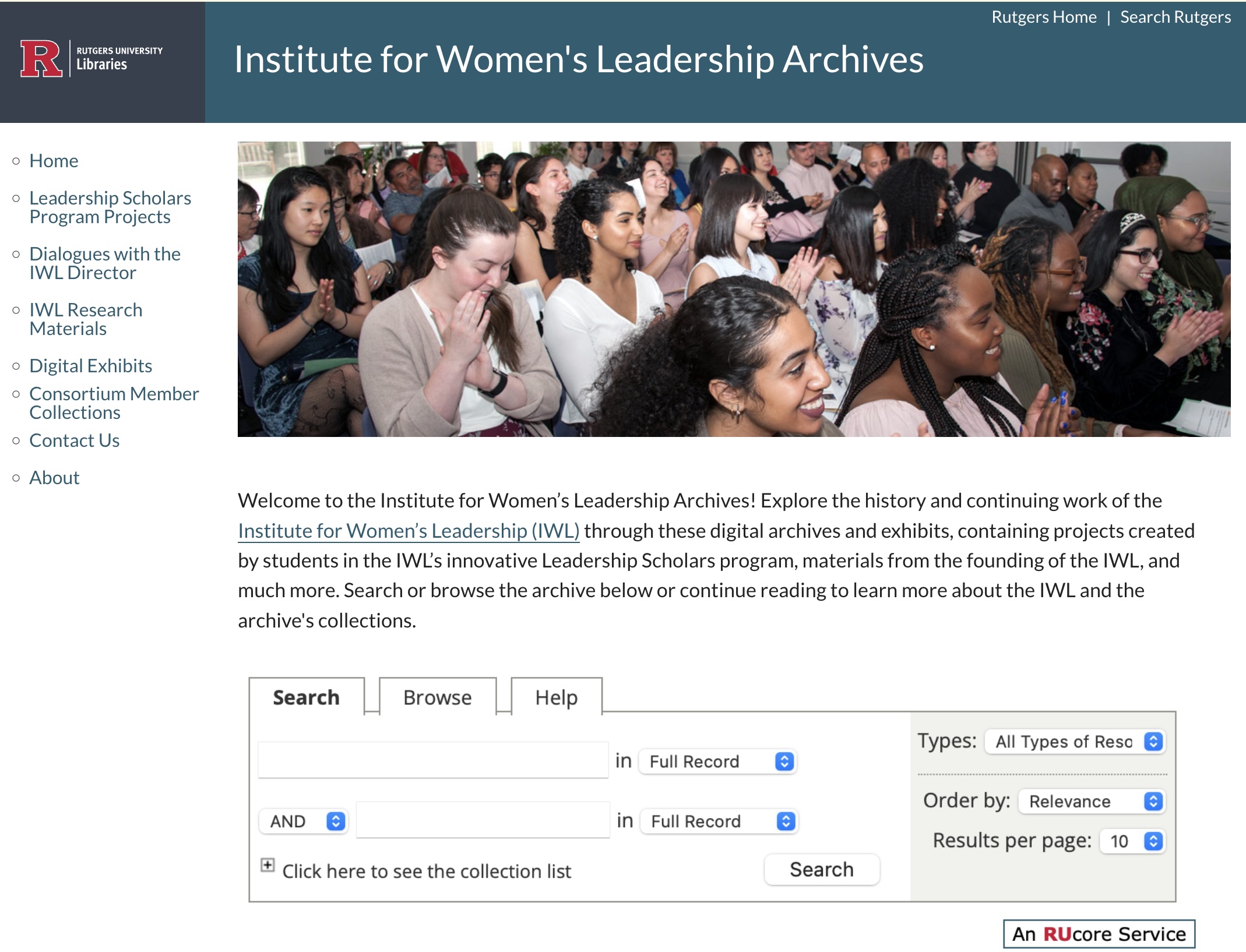
As of now, the digital archive project is in full swing. I started off my contributions to the project by creating a mockup of the user interface for the completed digital archive: a website with multiple pages that allow a user to explore and search the resources stored in RUcore. Since then, the project team has been working to assemble the many details that will go into making the finalized version of the digital archive a reality. (A screenshot of the homepage of this first-draft mockup, which borrows significantly from the HTML design of the robust Alcohol Studies digital archive, is shown below.)
 Throughout the process, Kayo and I have been working with the RUL digital team, which has helped shape our decisions on practical concerns such as copyright law, digital storage, and metadata schema. Sasha Taner, IWL’s Program Director and Research Coordinator, has helped guide the project with the IWL’s vision and purpose in mind. Kayo and I have been working to merge the information science world of RUL with the feminist world of the IWL by exploring what a functional feminist digital archive looks like. So far, our work has been informed by this query in several ways. In our descriptive metadata, we strive to ensure that the resources are represented through an intergenerational feminist lens that equitably describes all the women who have created and have been featured in the various resources, whether they are undergraduate student interviewers or interviewees at the top of their field. We are also carefully working to find ways to include descriptive metadata that facilitate equitable access to resources regardless of participants’ and creators’ race, ethnicity, sexuality, etc. Additionally, we have been taking steps to ensure all resources meet proper accessibility guidelines.
Moving into 2026, there is lots more exciting work to be done. I look forward to continuing to collaborate on envisioning a feminist digital archive for the IWL, bringing the final product to fruition, and getting to share it with the broader Rutgers community and beyond.